


 Adriaen van Ostade - The Two Gossips (copy) - n.d.
from $27.99
Hoodie

Adriaen van Ostade - The Quacksalver (copy) - n.d.
Garment
Hoodie
from $27.99
Ships within 3–7 business days. Free shipping to U.S. addresses.
Bulk offer: any 3 items 10% off, 5 items 20%, 10 items 30%. Applied automatically in the cart.
- Free shipping on all U.S. orders. Flat-rate international shipping: $19.99 USD.
- Made to order. Orders are processed and shipped within 3–7 business days.
- Damaged or misprinted? Free replacement. Report it within 30 days of delivery. Refund & return policy
About this design
Adriaen van Ostade - The Quacksalver (copy) - n.d. - Hoodie
A crowd of villagers gathers around a quack doctor performing from a makeshift stage in this seventeenth-century Dutch etching, now reproduced on a hoodie.
Visual Elements & Composition
The image is built from parchment beige, sepia ink and dark brown, so the etched lines read like an aged printed sheet. The performer stands at the center behind a wooden barrel that serves as his counter, beneath a draped canopy. A large oak tree fills one side of the scene, and a tight cluster of villagers and children leans in around him. The image sits in an oval vignette on a rectangular sheet, with the signature "N. Ostade" marked in the corner.
Meaning & Symbolism
A quacksalver was a traveling charlatan who sold cures in marketplaces, relying on theatrics to win over the working people gathered around him. Ostade turns that scene into a commentary on gullibility and on the way commerce, medicine and entertainment blurred together. The crowd's curiosity and the performer's showmanship make the etching a record of the era's skepticism toward anyone who profited from the desperation of ordinary people. Ostade, a student of Frans Hals and a contemporary of Rembrandt, was a leading Dutch Golden Age printmaker who set aside grand histories to chronicle village life with observant humor.
Why It Suits a Hoodie
The etching is about people standing close together, watching and talking, and a hooded sweatshirt is worn in exactly that kind of close, everyday setting. The dense linework and tight group of onlookers reward a viewer who is near the image rather than far from it. Wearing this design puts you in the crowd around the performer, which is the position Ostade invites the viewer to take.
Same design, other garments
More like this
-
Adriaen van Ostade - The Two Gossips (copy) - n.d.
from $27.99
Hoodie
-
 Adriaen van Ostade - The Quacksalver - 1648
from $19.99
T-Shirt
-
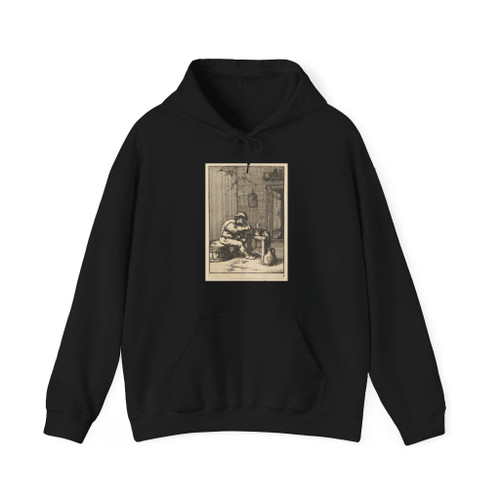 Adriaen van Ostade - Smoker (copy) - 1610–85
from $27.99
Hoodie
-
 Adriaen van Ostade - The Family (reverse copy) - 1610–85
from $27.99
Hoodie
-
 Adriaen van Ostade - The Family - 1647
from $27.99
Hoodie