


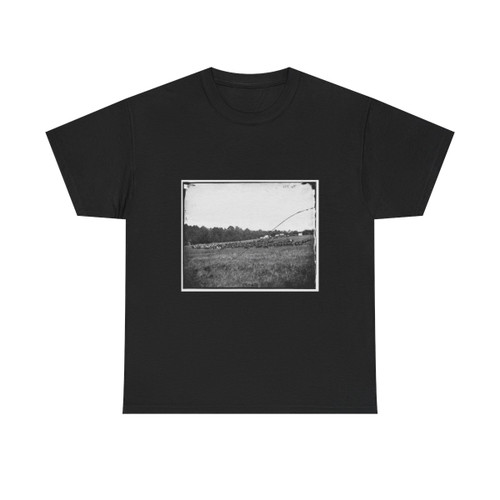
 Culpeper, Va. Battery a, 4Th U.S. Artillery, Robertson's Brigade (U.S. Civil War)
from $19.99
T-Shirt

Battery a, Fourth U.S. Artillery, Robertson's Brigade (U.S. Civil War)
Garment
T-Shirt
from $19.99
Ships within 3–7 business days. Free shipping to U.S. addresses.
Bulk offer: any 3 items 10% off, 5 items 20%, 10 items 30%. Applied automatically in the cart.
- Free shipping on all U.S. orders. Flat-rate international shipping: $19.99 USD.
- Made to order. Orders are processed and shipped within 3–7 business days.
- Damaged or misprinted? Free replacement. Report it within 30 days of delivery. Refund & return policy
- Material
- Solid colors: 100% cotton. Heather/Tweed/Russet: 50% cotton, 50% polyester. Sport Grey/Antique: 90% cotton, 10% polyester.
- Production
- Printed using Direct-to-Garment (DTG) technology for vibrant, lasting designs.
- Origin
- Printed in the USA on imported garments (Nicaragua).
About this design
Battery a, Fourth U.S. Artillery, Robertson's Brigade (U.S. Civil War) T-Shirt
A sepia albumen print from February 1864 showing the horses, wagons and canvas tents of an artillery battery's encampment in an open field.
Visual Elements & Composition
The camp spreads across the middle of the frame, with canvas tents and covered supply wagons set out in rows on the grass. Horses stand among the wagons, and a dark band of forest treeline closes the view at the back. The photograph sits within a rectangular mat, and its lettering is printed across the top: BATTERY A. FOURTH U. S. ARTILLERY. ROBERTSON'S BRIGADE. The tones run from warm sepia and dark brown through pale cream, with olive grey in the grass and foliage, so the whole scene reads as one soft, monochrome field.
Meaning & Symbolism
The image records the daily setting of a Union artillery unit during the American Civil War. James and Alexander Gardner made the photograph in 1864, and it appeared as Plate 59 in Gardner's Photographic Sketch Book of the War, Volume II, published in 1866. Its subject is the work of the battery itself: the horses, the supply wagons and the tents that kept a field unit moving and housed its men. The plain, documentary framing presents military life as it was, without ceremony.
Reading the Camp on the Shirt
A scene this wide with many small figures and objects is best seen from a little distance, where the rows of tents, the wagons and the treeline separate clearly. The print carries across the chest, so the full camp stays in view when the wearer is standing or walking.
Same design, other garments
More like this
-
Culpeper, Va. Battery a, 4Th U.S. Artillery, Robertson's Brigade (U.S. Civil War)
from $19.99
T-Shirt
-
 Battery a, 4Th U.S. Artillery (U.S. Civil War)
from $19.99
T-Shirt
-
 Culpeper, Va. Officers of the U.S. Horse Artillery Brigade Commanded by Capt. James M. Robertson (U.S. Civil War)
from $19.99
T-Shirt
-
 B.H. Robertson (U.S. Civil War)
from $19.99
T-Shirt
-
 B.H. Robertson, Va. (U.S. Civil War)
from $19.99
T-Shirt