


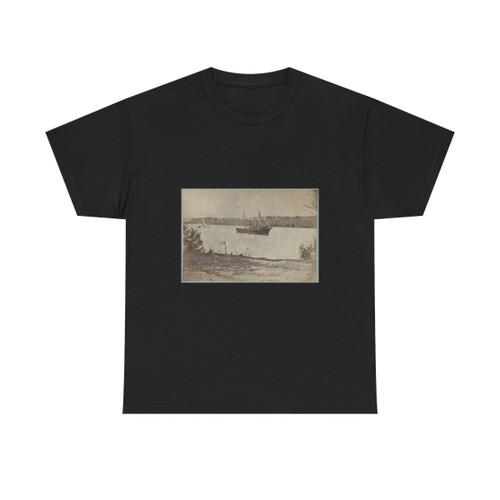
 James River, Va. Another View of the Dutch Gap Canal (U.S. Civil War)
from $19.99
T-Shirt

Butler's Dutch Gap Canal, James River, Virginia (U.S. Civil War)
Garment
T-Shirt
from $19.99
Ships within 3–7 business days. Free shipping to U.S. addresses.
Bulk offer: any 3 items 10% off, 5 items 20%, 10 items 30%. Applied automatically in the cart.
- Free shipping on all U.S. orders. Flat-rate international shipping: $19.99 USD.
- Made to order. Orders are processed and shipped within 3–7 business days.
- Damaged or misprinted? Free replacement. Report it within 30 days of delivery. Refund & return policy
- Material
- Solid colors: 100% cotton. Heather/Tweed/Russet: 50% cotton, 50% polyester. Sport Grey/Antique: 90% cotton, 10% polyester.
- Production
- Printed using Direct-to-Garment (DTG) technology for vibrant, lasting designs.
- Origin
- Printed in the USA on imported garments (Nicaragua).
About this design
Butler's Dutch Gap Canal, James River, Virginia (U.S. Civil War) T-Shirt
A sepia albumen photograph of soldiers labouring inside a deep earthen cut, with a timber trestle bridge spanning the ravine behind them.
Visual Elements & Composition
The palette is almost entirely sepia, with warm brown earth, pale cream highlights and dark brown shadows. The eye moves down into the cut, where the clay banks rise on either side of the workers. A wooden trestle bridge crosses the ravine in the middle distance, and bare trees stand along the ridge above. The photograph sits within a nested rule border, which frames the scene as a documentary view.
Meaning & Symbolism
The image records the Dutch Gap Canal on the James River in Virginia, dug in 1864 and 1865. General Benjamin Butler led the Union project to cut a route that bypassed Confederate batteries on Farrar's Island. The men shown are United States Colored Troops, African American soldiers who did the hard labour of the cut. The picture stands as a visual record of their military service and of the engineering effort of a pivotal period in American history.
Carried on the Chest
A scene this wide and deep reads best when the whole cut is visible at once, so the composition is kept large across the front of the shirt. The earthwork, bridge and ridge line stay in view from a few feet away, which is how a documentary photograph is meant to be seen.
Same design, other garments
More like this
-
James River, Va. Another View of the Dutch Gap Canal (U.S. Civil War)
from $19.99
T-Shirt
-
 James River, Va. View of the Completed Dutch Gap Canal (U.S. Civil War)
from $19.99
T-Shirt
-
 Dutch Gap, Va. The Canal Under Construction (U.S. Civil War)
from $19.99
T-Shirt
-
 James River, Virginia. U.S. Gunboat Massasoit (U.S. Civil War)
from $19.99
T-Shirt
-
 Looking Down James River From Dutch Gap, February 1865 (U.S. Civil War)
from $19.99
T-Shirt