CoA Hungary Country History Charles I Hoodie: Design Overview
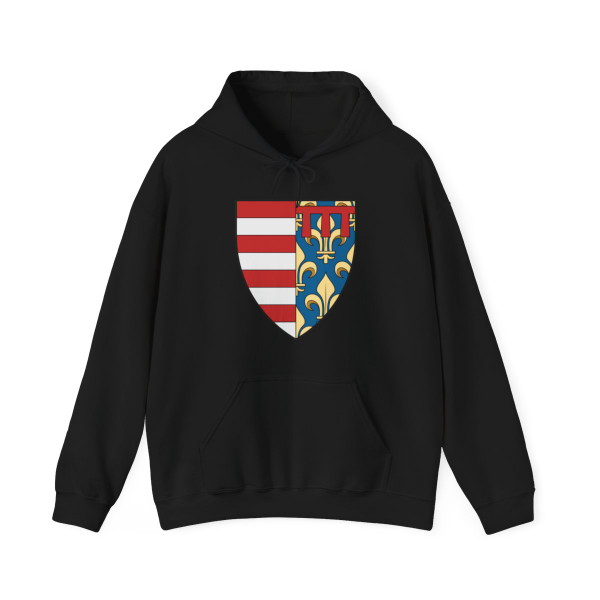
This hoodie showcases a powerful heraldic design, directly reflecting the coat of arms used in Hungary during the reign of King Charles I (Charles Robert of Anjou) from 1310 to 1342. The design is a vivid testament to a pivotal moment in Hungarian history, where a new ruler sought to legitimize his claim by merging his own heritage with the traditions of the land.
The Shield's Quartered Design
The central element of the design is the quartered shield, or escutcheon, which dominates the visual narrative. This heraldic structure is split into four distinct sections, each carrying significant symbolic weight.
First and Fourth Quarters: The Árpád Lineage
The first and fourth quarters of the shield are visually identical, featuring the "Barry of eight gules and argent" design. This striking pattern of eight horizontal stripes, alternating between red (gules) and white (argent), represents the esteemed Árpád dynasty. It embodies the ancient Hungarian royal lineage, emphasizing continuity and tradition.
Second and Third Quarters: The House of Anjou
The second and third quarters are also mirror images. They display a field of blue (azure) that is "semy of fleur-de-lis or," meaning it is scattered with golden fleur-de-lis. This motif is a direct reference to the French origins of the House of Anjou, signifying the new royal dynasty's heritage and its connection to European nobility.
Combined Heritage
The overall design is a deliberate fusion of heraldic traditions. It speaks of a strategic effort to unify the past and present, integrating the Árpád dynasty's deep-rooted significance with the Anjou family's rise to power. The coat of arms, as represented on this design, represents a deliberate political statement and a powerful visual declaration of a kingdom's evolving identity.