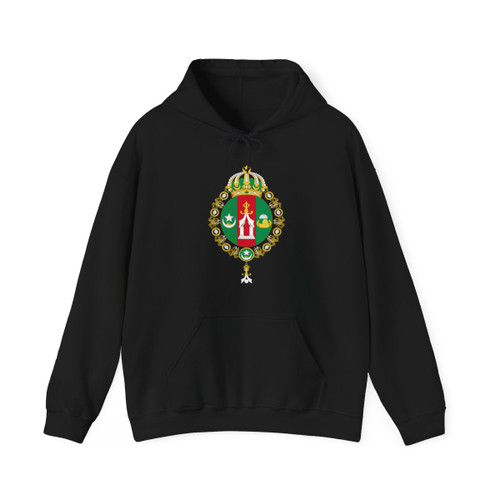
Coat of Arms of Spanish-ruled Philippines Hoodie: Design Overview
This hoodie showcases the Coat of Arms that represented the Philippines during the period of Spanish colonial rule, from approximately 1565 to 1898. The design is deeply rooted in Spanish heraldic tradition, offering a visual testament to the era.
Central Imagery and Symbolism
The centerpiece is the shield, the defining element of the design. Its layout typically reflects the components of the Spanish monarchy. Elements such as the castle, representing the Kingdom of Castile, and the lion, symbolizing the Kingdom of León, are often included, showcasing the dominant influence of Spain. The incorporation of arms representing kingdoms such as Aragon and Granada can also be present, providing a broader representation of the Spanish territories.
A smaller blue field or escutcheon, frequently found within the shield, holds three golden fleurs-de-lis. These stylized lilies are a direct reference to the Bourbon dynasty, the ruling family of Spain from the early 18th century. They serve as a powerful emblem of royal authority and the era’s dynastic rule over the Philippines.
Additional Elements
The design may feature a sea lion, a symbol that speaks to the Philippines as a maritime territory. The Royal crown, representing Spanish sovereignty, would usually rest atop the shield, reinforcing the message of colonial power. Furthermore, supporters—heraldic figures such as lions—could flank the shield, adding visual weight to the expression of authority.
This hoodie's design tells the story of Spanish colonial rule in the Philippines. It is a visual celebration of Spanish sovereignty and dynastic symbolism rather than local identity.