


 Dong Qichang - Landscapes and poems - early 17th century v10
from $27.99
Hoodie

Dong Qichang - Landscapes and poems - early 17th century v16
Garment
Hoodie
from $27.99
Ships within 3–7 business days. Free shipping to U.S. addresses.
Bulk offer: any 3 items 10% off, 5 items 20%, 10 items 30%. Applied automatically in the cart.
- Free shipping on all U.S. orders. Flat-rate international shipping: $19.99 USD.
- Made to order. Orders are processed and shipped within 3–7 business days.
- Damaged or misprinted? Free replacement. Report it within 30 days of delivery. Refund & return policy
About this design
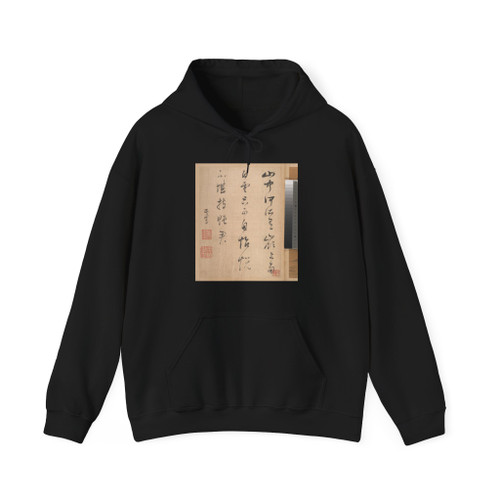
Dong Qichang - Landscapes and poems - early 17th century v16 - Hoodie
Four columns of running cursive ink script sit on a buff, lightly textured ground in this vertical leaf attributed to the late Ming master Dong Qichang.
Visual Elements & Composition
The columns move between heavy, dense strokes and lighter, dry-brushed passages, which gives the page a rhythm of weight and tone. A smaller signature column runs along the left margin, and two red seals sit near the lower left edge with a third at the lower right. The palette is restrained: ink black on parchment tan, with seal red as the single accent. The leaf is made of text alone, so the eye settles on the handwriting and the spacing between columns.
Meaning & Symbolism
Running-script calligraphy of this kind was often used to transcribe verse, and poems on mountains, seclusion and retirement were common choices. Within literati culture such leaves were valued for the personal quality of the brushwork as much as for the words, and they were often mounted in albums or joined with paintings as inscriptions. Dong Qichang (1555–1636) was a late Ming scholar-official, painter and critic, known as a leading theorist of the Southern School and as one of the most influential calligraphers of his era. His cursive hand drew on earlier Tang and Song models, and his writings and calligraphy were widely copied in the centuries that followed.
Printed on the Hoodie
Tall, narrow columns suit the front of a hoodie, where the heavier strokes can sit across the chest and the lighter lines fall toward the hem. The contrast between dense and dry-brushed passages stays visible as the garment moves, so the page keeps its character at both a glance and a closer look.
Same design, other garments
More like this
-
Dong Qichang - Landscapes and poems - early 17th century v10
from $27.99
Hoodie
-
 Dong Qichang - Landscapes and poems - early 17th century v4
from $27.99
Hoodie
-
 Dong Qichang - Landscapes and poems - early 17th century v3
from $27.99
Hoodie
-
 Dong Qichang - Landscapes and poems - early 17th century v8
from $27.99
Hoodie
-
 Dong Qichang - Landscapes and poems - early 17th century v14
from $27.99
Hoodie