


 Okumura Masanobu - Scene from a Drama - 1710–13
from $27.99
Hoodie
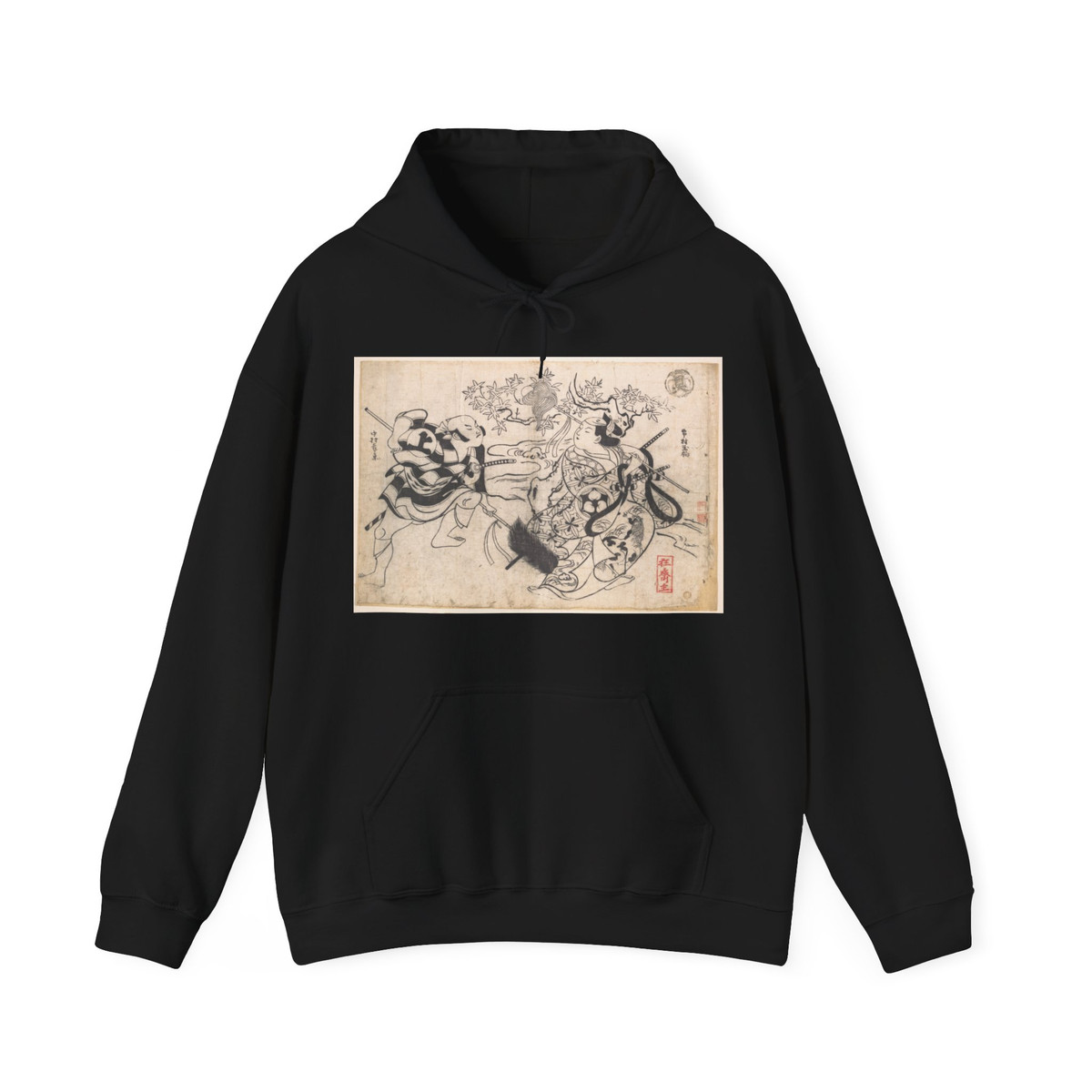
Okumura Masanobu - Two Actors in a Yari-odori, i.e. Spear Dance - 1710–13
Garment
Hoodie
from $27.99
Ships within 3–7 business days. Free shipping to U.S. addresses.
Bulk offer: any 3 items 10% off, 5 items 20%, 10 items 30%. Applied automatically in the cart.
- Free shipping on all U.S. orders. Flat-rate international shipping: $19.99 USD.
- Made to order. Orders are processed and shipped within 3–7 business days.
- Damaged or misprinted? Free replacement. Report it within 30 days of delivery. Refund & return policy
About this design
Okumura Masanobu - Two Actors in a Yari-odori, i.e. Spear Dance - 1710–13 - Hoodie
This ukiyo-e woodblock print shows two kabuki actors mid-performance in a Yari-odori, a ceremonial spear dance, drawn by Okumura Masanobu between 1710 and 1713.
Visual Elements & Composition
Warm paper beige fills most of the frame, with ink black carrying the figures, their patterned and striped kimono, and the swords they hold. Seal red appears only in small accents, which keeps the palette restrained. Maple branches and a stylized river sit around the performers, and a feathered fan-like prop adds movement. Vertical cartouches hold the carved and printed inscriptions, including the names 中村芳東, 市村玉柏 and 狂歌園主.
Meaning & Symbolism
The Yari-odori was a theatrical spear dance rooted in the Edo-period kabuki stage, and the print records its energy at a time when Japanese theatre was becoming a central subject for woodblock artists. The two actors, the swords and the seasonal maple reflect the dramatic, cultural mood of the work. Masanobu's print stands as an early example of how woodblock printing began to capture living theatre.
Wearing the Artwork
A hoodie wraps the artwork around the body, so the two dancers and their crossing blades move with the wearer as they walk and turn. The composition's vertical cartouches run along the lines of the garment, and the paper beige base reads as a quiet backdrop for the ink-black figures. Each wearer carries this print across the chest and back, as a piece of Edo-period theatre worn into everyday life.
Same design, other garments
More like this
-
Okumura Masanobu - Scene from a Drama - 1710–13
from $27.99
Hoodie
-
 Okumura Masanobu - The Actor Nakamura Kichibei - unknown
from $27.99
Hoodie
-
 Okumura Masanobu - Two Courtesans - unknown
from $27.99
Hoodie
-
 Okumura Masanobu - Two Figures - unknown
from $27.99
Hoodie
-
 Okumura Masanobu - The Actor Nakamuro Tomijuro as a Mounted Warrior - 1740
from $27.99
Hoodie