


 Heraldry
Thundorf-blazon (Switzerland) (Coat of Arms)
from $19.99
T-Shirt

Heraldry
Seuzach-blazon (Switzerland) (Coat of Arms)
Garment
T-Shirt
from $19.99
Ships within 3–7 business days. Free shipping to U.S. addresses.
Bulk offer: any 3 items 10% off, 5 items 20%, 10 items 30%. Applied automatically in the cart.
- Free shipping on all U.S. orders. Flat-rate international shipping: $19.99 USD.
- Made to order. Orders are processed and shipped within 3–7 business days.
- Damaged or misprinted? Free replacement. Report it within 30 days of delivery. Refund & return policy
- Material
- Solid colors: 100% cotton. Heather/Tweed/Russet: 50% cotton, 50% polyester. Sport Grey/Antique: 90% cotton, 10% polyester.
- Production
- Printed using Direct-to-Garment (DTG) technology for vibrant, lasting designs.
- Origin
- Printed in the USA on imported garments (Nicaragua).
About this design
Seuzach-blazon (Switzerland) (Coat of Arms) T-Shirt - Design
This t-shirt showcases the historic coat of arms of Seuzach, a municipality in the canton of Zürich, Switzerland. The design prominently features a heraldic representation, reflecting the town's heritage and connection to the von Heimenstein family.
Visual Elements
The core of the design is a black horse depicted rearing, a powerful and dynamic pose. The horse is complete with a red bridle and saddle, adding vibrant color and detail to the artwork. The background, described as "silver" in the blazon, is rendered in a suitable light color, which allows the black horse and red accoutrements to stand out.
Meaning and Symbolism
The rearing horse is the central symbol. Its presence evokes strength, nobility, and perhaps the historical importance of the von Heimenstein family, whose arms the design originates from. The bridle and saddle suggest control and readiness, while the overall composition hints at the area's rich past. The use of traditional heraldic colors and imagery provides a direct link to the region's history, commemorating a symbol adopted officially in 1860.
Same design, other garments
More like this
-
Heraldry
Thundorf-blazon (Switzerland) (Coat of Arms)
from $19.99
T-Shirt
-
 Heraldry
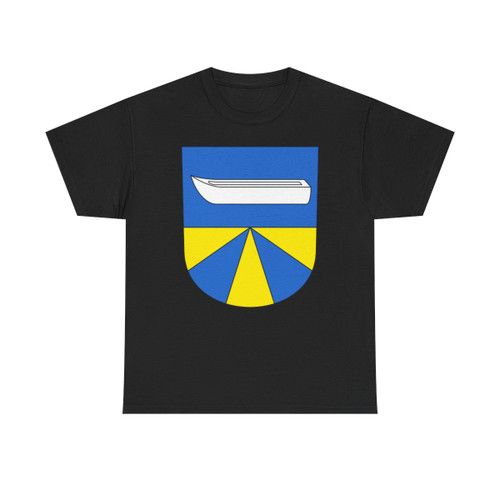
Seegräben-blazon (Switzerland) (Coat of Arms)
from $19.99
T-Shirt
-
 Heraldry
Wiedikon-blazon (Switzerland) (Coat of Arms)
from $19.99
T-Shirt
-
 Heraldry
Wil-blazon (Switzerland) (Coat of Arms)
from $19.99
T-Shirt
-
 Heraldry
Winznau-blazon (Switzerland) (Coat of Arms)
from $19.99
T-Shirt