


 Heraldry
Wijdewormer wapen 1817 (Netherlands) (Coat of Arms)
from $19.99
T-Shirt

Heraldry
Wijdewormer wapen 1949 (Netherlands) (Coat of Arms)
Garment
T-Shirt
from $19.99
Ships within 3–7 business days. Free shipping to U.S. addresses.
Bulk offer: any 3 items 10% off, 5 items 20%, 10 items 30%. Applied automatically in the cart.
- Free shipping on all U.S. orders. Flat-rate international shipping: $19.99 USD.
- Made to order. Orders are processed and shipped within 3–7 business days.
- Damaged or misprinted? Free replacement. Report it within 30 days of delivery. Refund & return policy
- Material
- Solid colors: 100% cotton. Heather/Tweed/Russet: 50% cotton, 50% polyester. Sport Grey/Antique: 90% cotton, 10% polyester.
- Production
- Printed using Direct-to-Garment (DTG) technology for vibrant, lasting designs.
- Origin
- Printed in the USA on imported garments (Nicaragua).
About this design
Wijdewormer Wapen 1949 T-Shirt Design
This striking design features the official coat of arms of the former municipality of Wijdewormer, Netherlands, as adopted in 1949. The artwork presents a rich tapestry of heraldic symbols, each imbued with historical and local significance.
The Escutcheon (Shield)
The central element is a shield of azure (blue), providing a vibrant backdrop for the other elements. A silver (argent) sheep, the principal charge, stands on a grassy ground of green. In its mouth, the sheep holds a clover leaf (trefoil) of sinople (green).
The Base
At the base of the shield, on a field of silver, a swimming eel (paling) in sable (black) adds a distinctive touch, highlighting the area's history of eel fishing.
The Crest
The shield is surmounted by a golden crown, a “crown of three leaves and two pearls,” which completes the design.
Symbolism
The overall design reflects Wijdewormer's history and heritage. The sheep symbolizes the area's strong livestock farming traditions. The clover leaf, held by the sheep, represents agriculture, pasture, and fertility, linking to the land's bounty. The eel in the shield base commemorates the importance of eel fishing prior to the area's conversion to agriculture. This is a design rich in heritage and historical context.
Same design, other garments
More like this
-
Heraldry
Wijdewormer wapen 1817 (Netherlands) (Coat of Arms)
from $19.99
T-Shirt
-
 Heraldry
Weesperkarspel wapen 1949 (Netherlands) (Coat of Arms)
from $19.99
T-Shirt
-
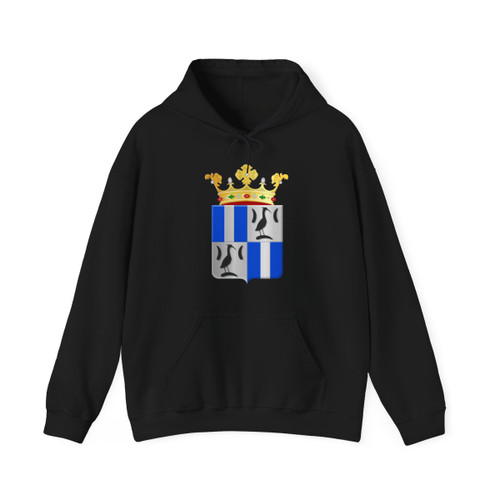 Heraldry
Weesperkarspel wapen 1949 (Netherlands) (Coat of Arms)
from $27.99
Hoodie
-
 Heraldry
Kerkrade wapen (Netherlands) (Coat of Arms)
from $19.99
T-Shirt
-
 Heraldry
Bergambacht wapen (Netherlands) (Coat of Arms)
from $19.99
T-Shirt