


 Dirk Maas , unknown - Portrait of Dirk Maas - 1669 - 1717
from $27.99
Hoodie

Dirk Maas - Portrait of Dirk Maas - 1669 - 1717
Garment
Hoodie
from $27.99
Ships within 3–7 business days. Free shipping to U.S. addresses.
Bulk offer: any 3 items 10% off, 5 items 20%, 10 items 30%. Applied automatically in the cart.
- Free shipping on all U.S. orders. Flat-rate international shipping: $19.99 USD.
- Made to order. Orders are processed and shipped within 3–7 business days.
- Damaged or misprinted? Free replacement. Report it within 30 days of delivery. Refund & return policy
About this design
Dirk Maas - Portrait of Dirk Maas - 1669 - 1717 - Hoodie
This engraved-style portrait shows the Dutch painter and etcher Dirk Maas as a bust-length figure in a long curled wig, held within an oval frame.
Visual Elements & Composition
The design is built on off-white, which fills about half the frame and gives the image its light base. Charcoal, mid gray, black and light gray carry the shading, so the sitter's face and wig stand out from the darker tones. The oval frame sets him at the centre, while an artist's palette with brushes and a drawing sheet with a small landscape sketch sit at the edges. A rectangular plate bears the numeral 1665, the only text in the image.
Meaning & Symbolism
Maas worked in the Dutch Golden Age, when portraits of artists signalled the social standing and professional dignity of the maker. The palette, brushes and landscape sketch name his trade directly, presenting him as both observer and interpreter of the world. He was known for cavalry engagements, hunting scenes and landscapes shaped by Dutch and Italianate traditions, and the sketch alludes to that landscape practice. The composition's restraint matches the dignified mood the image carries.
Wearing the Portrait
A hoodie places the artwork at chest height, so the oval frame reads as a portrait worn in front of the viewer rather than on a wall. The hood frames the upper body the way the frame holds the bust, and the sketch and palette sit at the edges where the eye moves across the fabric. Wearing this piece puts a 17th-century artist's likeness in an everyday setting.
Same design, other garments
More like this
-
Dirk Maas , unknown - Portrait of Dirk Maas - 1669 - 1717
from $27.99
Hoodie
-
 Dirk Maas, unknown - Horsemen - 1669 - 1717
from $27.99
Hoodie
-
 Dirk Maas - Rider Facing Right - 1669 - 1717
from $27.99
Hoodie
-
 Dirk Maas, unknown - Riding School - 1669 - 1717
from $27.99
Hoodie
-
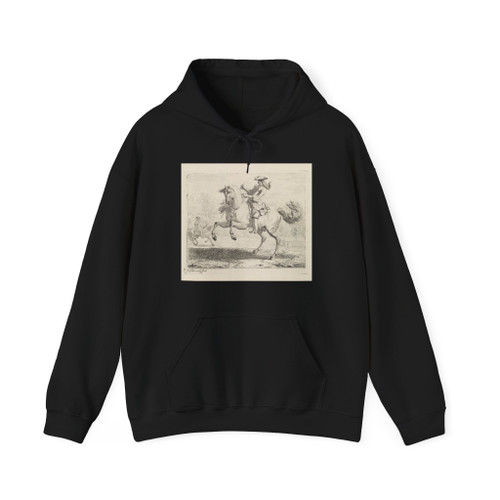 Dirk Maas , unknown - Rearing Horse with Rider - 1669 - 1717
from $27.99
Hoodie