


 Dirk Maas , unknown - Portrait of Dirk Maas - 1669 - 1717
from $27.99
Hoodie

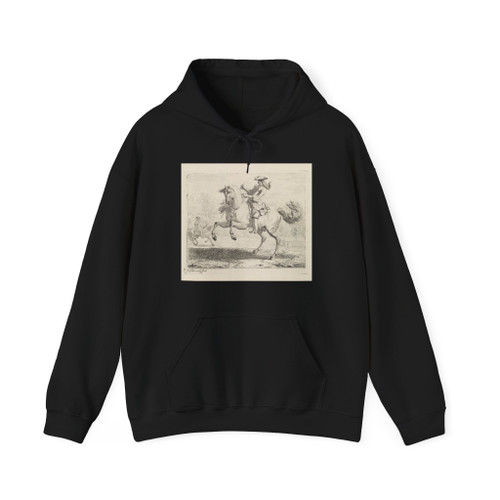
Dirk Maas, unknown - Riding School - 1669 - 1717
Garment
Hoodie
from $27.99
Ships within 3–7 business days. Free shipping to U.S. addresses.
Bulk offer: any 3 items 10% off, 5 items 20%, 10 items 30%. Applied automatically in the cart.
- Free shipping on all U.S. orders. Flat-rate international shipping: $19.99 USD.
- Made to order. Orders are processed and shipped within 3–7 business days.
- Damaged or misprinted? Free replacement. Report it within 30 days of delivery. Refund & return policy
About this design
Dirk Maas, unknown - Riding School - 1669 - 1717 - Hoodie
This copperplate engraving shows a rearing white horse at the centre of a riding school, held in balance by a trainer working a longe line.
Visual Elements & Composition
Off-white paper dominates the design, with sepia and grey inks building the courtyard, brick enclosure wall and distant figures. The rearing horse is the sharpest point in the scene, lifted above the ground in a controlled airs-above-the-ground movement. Vertical posts and rails set the ring's structure, while an arched wall opening and a garden statue frame the background. Small riders on horseback sit far off, so the eye moves from the horse in the foreground to the open space beyond.
Meaning & Symbolism
Dirk Maas was a Dutch painter and printmaker of the Golden Age, known for battle scenes, landscapes and animal subjects. In this manege, the training of the horse stands for discipline and refined skill. In the seventeenth century, a well-schooled horse signalled status and mastery, and the rider's control over a powerful animal reflected the same order people hoped to see in their own world. The engraving's measured lines carry that sense of restraint.
Wearing the Riding School Scene
A hoodie gives this scene a different kind of stage. The horse and trainer read as a single figure across the chest, and the arched opening and wall lines run with the body's natural shape. The composition is built for a close look, so the detail of the longe line, the rails and the distant riders stays visible up close. Each time the wearer moves, the rearing horse shifts with them.
Same design, other garments
More like this
-
Dirk Maas , unknown - Portrait of Dirk Maas - 1669 - 1717
from $27.99
Hoodie
-
 Dirk Maas, unknown - Horsemen - 1669 - 1717
from $27.99
Hoodie
-
 Dirk Maas - Portrait of Dirk Maas - 1669 - 1717
from $27.99
Hoodie
-
 Dirk Maas , unknown - Rearing Horse with Rider - 1669 - 1717
from $27.99
Hoodie
-
 Dirk Maas - Rider Facing Right - 1669 - 1717
from $27.99
Hoodie