


 unknown - Book of Plowing and Weaving - 1696 v25
from $27.99
Hoodie

unknown - Book of Plowing and Weaving - 1696 v1
Garment
Hoodie
from $27.99
Ships within 3–7 business days. Free shipping to U.S. addresses.
Bulk offer: any 3 items 10% off, 5 items 20%, 10 items 30%. Applied automatically in the cart.
- Free shipping on all U.S. orders. Flat-rate international shipping: $19.99 USD.
- Made to order. Orders are processed and shipped within 3–7 business days.
- Damaged or misprinted? Free replacement. Report it within 30 days of delivery. Refund & return policy
About this design
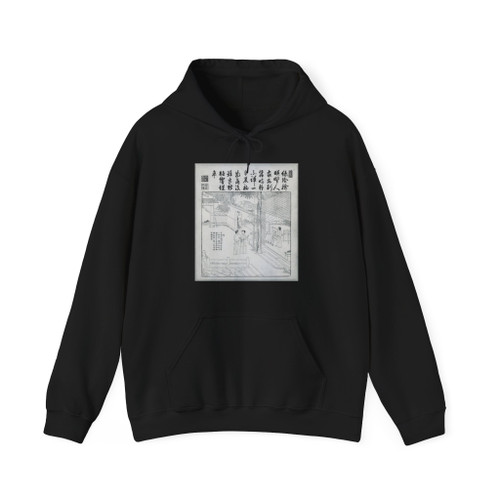
unknown - Book of Plowing and Weaving - 1696 v1 - Hoodie
This design reproduces a scene of rural labour: a tiled-roof pavilion where women work at their looms beside a quiet waterside, rendered as a black-and-white woodblock-style line engraving.
Visual Elements & Composition
Grey dominates the palette, covering roughly 60% of the image, with off-white across about 30% and black accents across the remaining 10%. The scene sits inside a rectangular framed panel, organised by vertical columns and the curved eaves of the pavilion roof. Three figures occupy the pavilion: two seated women working and a standing attendant. Around them are a pine tree, a bamboo grove, a wooden railing at the water's edge, and a small bird perched on a branch. Columns of Chinese characters run through the composition, reinforcing its orderly, instructive character.
Meaning & Symbolism
The design draws on the Book of Plowing and Weaving, an illustrated album of agricultural and textile work dated to 1696, during the Qing Dynasty. Its paired subjects, plowing and weaving, present farming and cloth-making as the two foundations of domestic life. The pavilion, bamboo and pine signal a cultivated setting, while the working figures keep the emphasis on labour and craftsmanship. The mood is measured and agrarian, honouring the skill behind everyday production.
Why This Hoodie Suits the Artwork
A hooded sweatshirt gives the framed panel a broad, continuous surface to carry the scene, and the vertical columns of the composition run naturally down the body. The curve of the hood echoes the curved roof eaves, so the pavilion's outline meets the wearer's shoulders. Worn, the piece reads as a small piece of the same record of work that the original album preserved.
Same design, other garments
More like this
-
unknown - Book of Plowing and Weaving - 1696 v25
from $27.99
Hoodie
-
 unknown - Book of Plowing and Weaving - 1696 v6
from $27.99
Hoodie
-
 unknown - Book of Plowing and Weaving - 1696 v14
from $27.99
Hoodie
-
 unknown - Book of Plowing and Weaving - 1696 v21
from $27.99
Hoodie
-
 unknown - Book of Plowing and Weaving - 1696 v18
from $27.99
Hoodie