


 unknown - Book of Plowing and Weaving - 1696 v25
from $27.99
Hoodie

unknown - Book of Plowing and Weaving - 1696 v14
Garment
Hoodie
from $27.99
Ships within 3–7 business days. Free shipping to U.S. addresses.
Bulk offer: any 3 items 10% off, 5 items 20%, 10 items 30%. Applied automatically in the cart.
- Free shipping on all U.S. orders. Flat-rate international shipping: $19.99 USD.
- Made to order. Orders are processed and shipped within 3–7 business days.
- Damaged or misprinted? Free replacement. Report it within 30 days of delivery. Refund & return policy
About this design
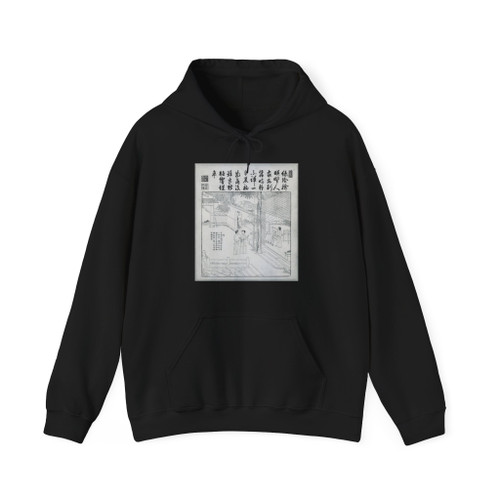
unknown - Book of Plowing and Weaving - 1696 v14 - Hoodie
This design reproduces a scene of rural labour, with figures working beside a riverbank under a pitched roof, drawn in black ink on an off-white ground.
Visual Elements & Composition
Off-white dominates the composition, with black ink carrying every line. The scene sits inside a rectangular framed panel, and vertical columns of calligraphy run along its edge, giving the piece the structure of a printed page. At the centre, a stilt house rises on posts with a raised wooden gallery, and a pitched tiled roof caps the building. Women tend silkworms on the balcony and hang bundles of branches to dry, while a woman carries a basket down a staircase toward a river lined with reeds and rocks. The lines are crisp and economical, with the woodblock-style print leaving clear negative space around each figure.
Meaning & Symbolism
The scene connects two central pursuits of agrarian life: cultivating the land and producing cloth. Silk tending and the drying of branches show the textile work that followed the harvest, and the riverside setting ties that work to the water and seasons that governed it. The stilt house and the figures moving between house, stairs and river show labour and daily routine as one continuous cycle. The calligraphic columns frame the scene as a text-based work, in keeping with the way the 1696 Book of Plowing and Weaving joined image and writing to describe agricultural and craft knowledge. The original artwork comes from the Qing dynasty, and this design reflects that era's illustrative style.
On the Hooded Sweatshirt
A hoodie gives this artwork a broad, continuous surface to work across. The stilt house and river scene read as a single image when the garment is worn, and the calligraphic columns run vertically with the body's natural lines. The off-white ground and black ink keep the composition clean, so the detail of the silkworm tending, the hanging branches and the riverside stairs stays legible as the wearer moves.
Same design, other garments
More like this
-
unknown - Book of Plowing and Weaving - 1696 v25
from $27.99
Hoodie
-
 unknown - Book of Plowing and Weaving - 1696 v6
from $27.99
Hoodie
-
 unknown - Book of Plowing and Weaving - 1696 v1
from $27.99
Hoodie
-
 unknown - Book of Plowing and Weaving - 1696 v18
from $27.99
Hoodie
-
 unknown - Book of Plowing and Weaving - 1696 v21
from $27.99
Hoodie