


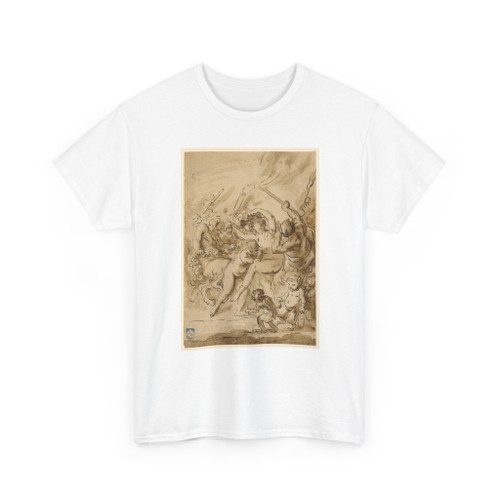
 Jacob de Wit, 1695 – 1754 - Children; Verso- Children and Bacchantes () - 1725–1754
from $19.99
T-Shirt

Jacob de Wit, 1695 – 1754 - Bacchanal of Children - 1725–1754
Garment
T-Shirt
from $19.99
Ships within 3–7 business days. Free shipping to U.S. addresses.
Bulk offer: any 3 items 10% off, 5 items 20%, 10 items 30%. Applied automatically in the cart.
- Free shipping on all U.S. orders. Flat-rate international shipping: $19.99 USD.
- Made to order. Orders are processed and shipped within 3–7 business days.
- Damaged or misprinted? Free replacement. Report it within 30 days of delivery. Refund & return policy
About this design
Jacob de Wit, 1695 – 1754 - Bacchanal of Children - 1725–1754 - T-Shirt
A small pen and brown ink sketch of three loosely drawn children caught mid-revel, set inside a thin ruled border on warm grey paper.
Visual Elements & Composition
The grey ground fills most of the frame, with ink black outlines doing the work. A child crouches at the left, head bent low; a second stands at the centre with one arm thrown high and the body twisting toward the lower middle; a third reclines at the lower right, head turned upward beside a rounded form that may be an animal. The figures carry little interior shading. Pale highlights and a faint dark grey wash sit behind them, and a cream border holds the whole scene in a wide horizontal panel.
Meaning & Symbolism
The title names the subject as a bacchanal, a revel in the manner of the Bacchic festivals of classical myth, where followers of Bacchus gave themselves to wine, dance and noise. Eighteenth-century artists often cast infants and children in place of adult revellers, so abandon read as play rather than threat. The sketch was made by Jacob de Wit (1695–1754), the Dutch painter known for decorative panels of putti and children set into architectural schemes. The dates place it in his later working years, and studies like this were drawn as preparatory work for larger compositions.
Built for the Motion in the Drawing
The figures in this sketch are all in motion, twisting, reaching and leaning into one another, and that energy translates well to a shirt worn in daily movement. The design sits at chest height, where the eye reads the central raised arm first and then follows the children outward. Wearing it puts that loose, lively gesture in direct view of everyone nearby.
Same design, other garments
More like this
-
Jacob de Wit, 1695 – 1754 - Children; Verso- Children and Bacchantes () - 1725–1754
from $19.99
T-Shirt
-
 Jacob de Wit, 1695 – 1754 - Design for a Painting, Five Putti - 1725–1754
from $19.99
T-Shirt
-
 Jacob de Wit, 1695 – 1754 - Design for a Painting, Two Flying Putti - 1725–1754
from $19.99
T-Shirt
-
 Jacob de Wit, 1695 – 1754 - Bacchantes - ca. 1750
from $19.99
T-Shirt
-
 Jacob de Wit, 1695 – 1754 - The Young Bacchus with Two Companions - ca. 1750
from $19.99
T-Shirt