


 Jacob de Wit, 1695 – 1754 - Design for a Painting, Five Putti - 1725–1754
from $19.99
T-Shirt

Jacob de Wit, 1695 – 1754 - Design for a Painting, Two Flying Putti - 1725–1754
Garment
T-Shirt
from $19.99
Ships within 3–7 business days. Free shipping to U.S. addresses.
Bulk offer: any 3 items 10% off, 5 items 20%, 10 items 30%. Applied automatically in the cart.
- Free shipping on all U.S. orders. Flat-rate international shipping: $19.99 USD.
- Made to order. Orders are processed and shipped within 3–7 business days.
- Damaged or misprinted? Free replacement. Report it within 30 days of delivery. Refund & return policy
About this design
Jacob de Wit, 1695 – 1754 - Design for a Painting, Two Flying Putti - 1725–1754 - T-Shirt
A pen, brown wash and white-heightened study by Jacob de Wit, showing two winged infant figures drifting through a cloudy sky.
Visual Elements & Composition
The sheet is built from warm ochre and deep brown ink, with white chalk lifting the highlights on flesh and cloud. The upper putto hovers at the left, half-turned, with drapery swept behind him. The larger second putto reclines diagonally across the lower centre, one arm extended and his head tilted back toward the viewer. The loose, rapid handling keeps the figures open and the composition irregular and oval, so the eye moves in a slow loop from one figure to the other.
Meaning & Symbolism
Putti were a staple of Baroque and Rococo decorative painting, where they carried garlands, ribbons and the attributes of the gods across palace and church ceilings. This drawing is a working design for that kind of scheme. It let a patron and a workshop settle the placement, foreshortening and movement of the figures before the costly work of painting on plaster began. Jacob de Wit (1695–1754) was a Dutch painter known for grisaille figures and decorative interiors in the Rococo taste, and this sheet, from the later part of his career, shows his concern with gesture and the illusion of weightlessness.
Built for the Tee
A tee carries the whole figure group across the chest, so the drifting putti read at a glance from across the room. The reclining figure's tilted head and extended arm sit naturally on the wearer's torso, and the warm ochre ground gives the print a soft, sky-like tone against everyday clothing.
Same design, other garments
More like this
-
Jacob de Wit, 1695 – 1754 - Design for a Painting, Five Putti - 1725–1754
from $19.99
T-Shirt
-
 Jacob de Wit, 1695 – 1754 - Bacchanal of Children - 1725–1754
from $19.99
T-Shirt
-
 Jacob de Wit, 1695 – 1754 - Children; Verso- Children and Bacchantes () - 1725–1754
from $19.99
T-Shirt
-
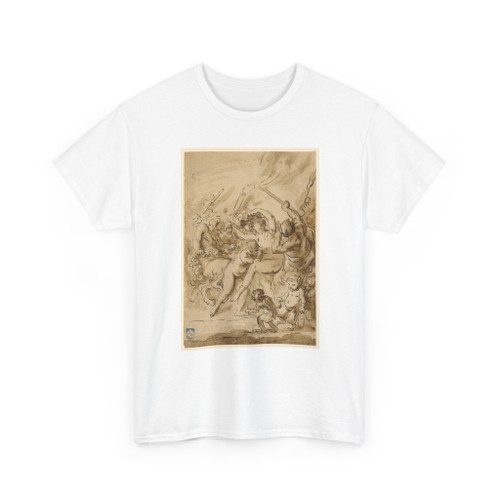 Jacob de Wit, 1695 – 1754 - Bacchantes - ca. 1750
from $19.99
T-Shirt
-
 Jacob de Wit, 1695 – 1754 - Putti playing before a herm - 1750–1752
from $19.99
T-Shirt