


 Jacob de Wit, 1695 – 1754 - Design for a Painting, Two Flying Putti - 1725–1754
from $19.99
T-Shirt

Jacob de Wit, 1695 – 1754 - Design for a Painting, Five Putti - 1725–1754
Garment
T-Shirt
from $19.99
Ships within 3–7 business days. Free shipping to U.S. addresses.
Bulk offer: any 3 items 10% off, 5 items 20%, 10 items 30%. Applied automatically in the cart.
- Free shipping on all U.S. orders. Flat-rate international shipping: $19.99 USD.
- Made to order. Orders are processed and shipped within 3–7 business days.
- Damaged or misprinted? Free replacement. Report it within 30 days of delivery. Refund & return policy
About this design
Jacob de Wit, 1695 – 1754 - Design for a Painting, Five Putti - 1725–1754 - T-Shirt
This is a grey wash drawing with white heightening, showing five putti grouped around a squared block and stepped base beneath a faint cloud.
Visual Elements & Composition
Warm grey paper dominates the sheet, with soft light grey washes and dark grey ink giving the figures their modelling. Touches of white lift the flesh and drapery, so the forms read clearly against the ground. Two putti sit at the centre, one leaning on the upper edge of the block while another rises behind it. A third reaches over the top from the right, and a winged putto, seated on a cloud, looks down from the upper right. A fifth crouches at the lower left, pressing against the base. A faint cloud outline sits at the upper left. The layout is busy and overlapping, which gives the centre of the composition its energy.
Meaning & Symbolism
Putti were a stock device of Baroque decorative painting. Children and winged figures could carry an allegory, a celebration or a sacred theme without the weight of human narrative. The block may stand for an altar, a pedestal or a plinth for a sculpture. This is a design rather than a finished work, so its arrangement of figures shows how the group would sit within a larger painted scheme. The artist, Jacob de Wit, was a Dutch painter (1695 to 1754) known for decorative schemes of putti and mythological figures for interiors. The title dates the design to between about 1725 and 1754.
Carried on the Tee
The full sheet, with its grouped figures and cloud at the upper left, is printed across the chest, so the composition reads at a glance from across the room. The putti’s overlapping poses fill the shirt front, letting the eye move from the central pair out to the winged figure above and the crouching putto below. Wearing the design puts the study of a decorative painting on the body, where its lively arrangement is seen up close.
Same design, other garments
More like this
-
Jacob de Wit, 1695 – 1754 - Design for a Painting, Two Flying Putti - 1725–1754
from $19.99
T-Shirt
-
 Jacob de Wit, 1695 – 1754 - Bacchanal of Children - 1725–1754
from $19.99
T-Shirt
-
 Jacob de Wit, 1695 – 1754 - Children; Verso- Children and Bacchantes () - 1725–1754
from $19.99
T-Shirt
-
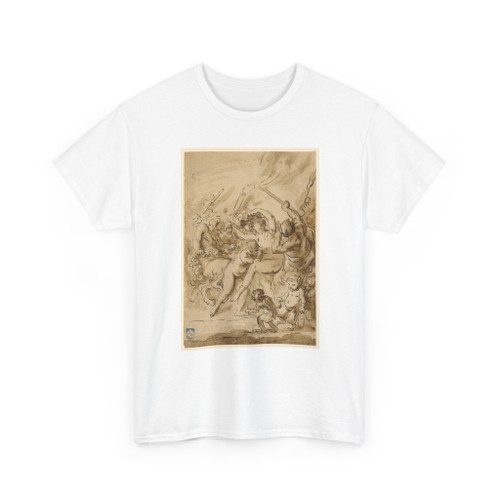 Jacob de Wit, 1695 – 1754 - Bacchantes - ca. 1750
from $19.99
T-Shirt
-
 Jacob de Wit, 1695 – 1754 - Putti playing before a herm - 1750–1752
from $19.99
T-Shirt