


 Jacob de Wit, 1695 – 1754 - Bacchanal of Children - 1725–1754
from $19.99
T-Shirt

Jacob de Wit, 1695 – 1754 - Children; Verso- Children and Bacchantes () - 1725–1754
Garment
T-Shirt
from $19.99
Ships within 3–7 business days. Free shipping to U.S. addresses.
Bulk offer: any 3 items 10% off, 5 items 20%, 10 items 30%. Applied automatically in the cart.
- Free shipping on all U.S. orders. Flat-rate international shipping: $19.99 USD.
- Made to order. Orders are processed and shipped within 3–7 business days.
- Damaged or misprinted? Free replacement. Report it within 30 days of delivery. Refund & return policy
About this design
Jacob de Wit, 1695 – 1754 - Children; Verso- Children and Bacchantes () - 1725–1754 - T-Shirt
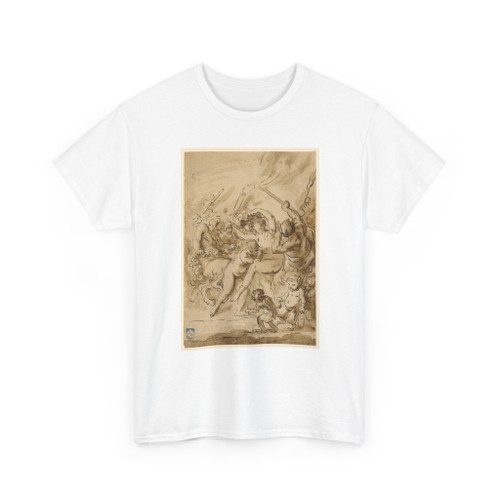
A small pen and grey wash sketch shows several children gathered inside a ruled border, their gestures linked by a long diagonal stick running through the group.
Visual Elements & Composition
The sheet is built from dark ink lines laid over a warm grey ground, with a cream mount framing the whole study. Ink black dominates the figures, while the paper tone fills most of the surface. A horizontal rectangle contains the scene: a figure stands at the left with the body turned and one arm bent, a seated child leans forward at the centre, and a taller child stands at the right, tilting toward the middle. Some heads are reduced to a few curved strokes, and a partly drawn head sits at the far right edge. The diagonal of the rod gives the arrangement its movement.
Meaning & Symbolism
The drawing is by Jacob de Wit, the Dutch painter who lived from 1695 to 1754 and was known for decorative work featuring putti and children. Groups of children like these were a common motif in eighteenth-century decorative drawing, where they stood for play and liveliness within larger schemes. The quick, broken strokes suggest a preparatory study, worked out to test how the figures would sit together before a finished composition was fixed. The catalogue record notes a related drawing on the reverse, showing children and bacchantes, which places this sheet within that working practice.
Designed for the Chest, Seen at Arm's Length
A tee carries this sketch across a broad, flat surface, so the diagonal of the rod and the loose spacing of the children read as a single gesture from a few steps away. The ruled border becomes a clean frame on the shirt, and the open grey ground lets the ink lines of the figures stand out as they did on the original sheet.
Same design, other garments
More like this
-
Jacob de Wit, 1695 – 1754 - Bacchanal of Children - 1725–1754
from $19.99
T-Shirt
-
 Jacob de Wit, 1695 – 1754 - Bacchantes - ca. 1750
from $19.99
T-Shirt
-
 Jacob de Wit, 1695 – 1754 - Design for a Painting, Five Putti - 1725–1754
from $19.99
T-Shirt
-
 Jacob de Wit, 1695 – 1754 - Design for a Painting, Two Flying Putti - 1725–1754
from $19.99
T-Shirt
-
 Jacob de Wit, 1695 – 1754 - The Young Bacchus with Two Companions - ca. 1750
from $19.99
T-Shirt