


 Jacob de Wit, 1695 – 1754 - Children; Verso- Children and Bacchantes () - 1725–1754
from $19.99
T-Shirt
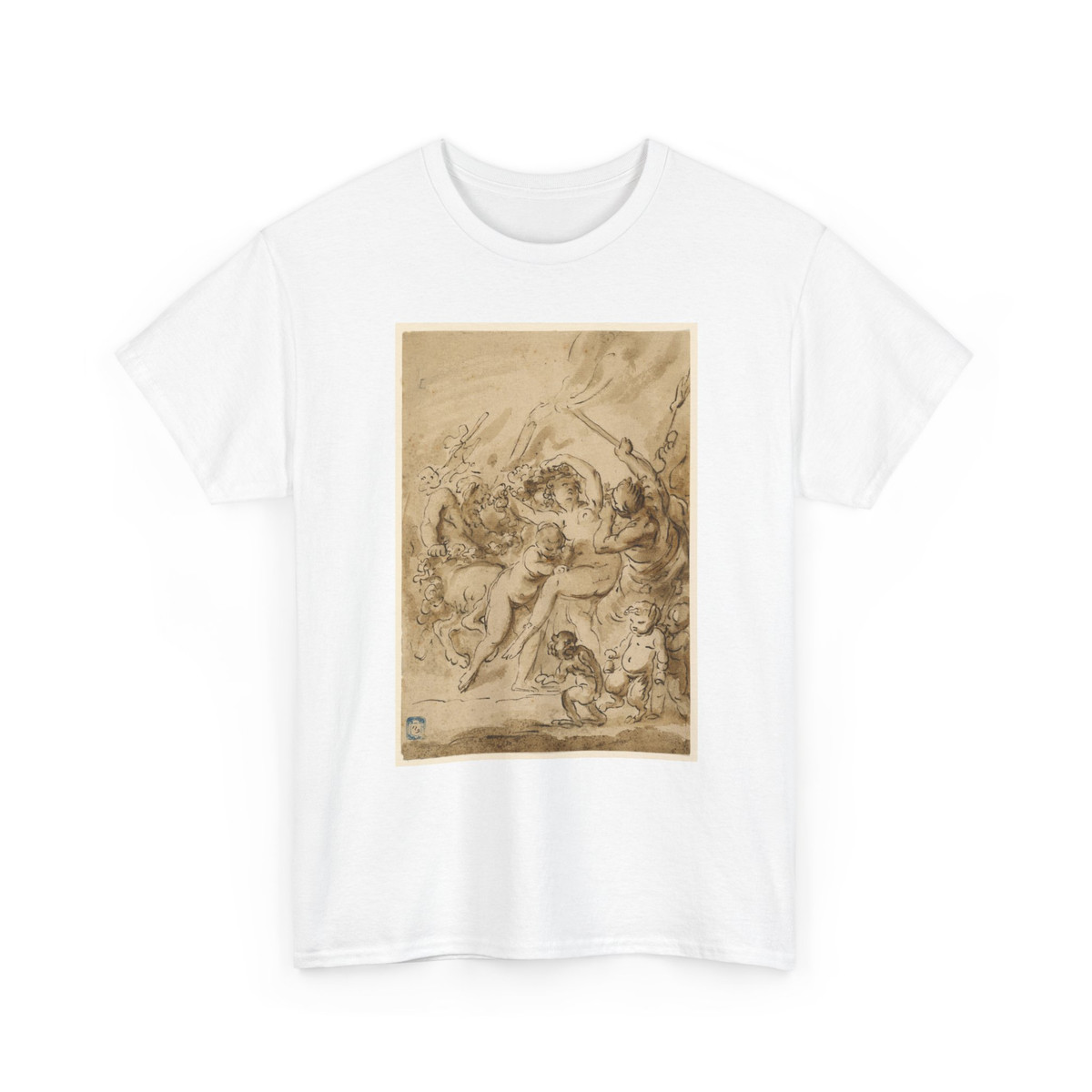
Jacob de Wit, 1695 – 1754 - Bacchantes - ca. 1750
Garment
T-Shirt
from $19.99
Ships within 3–7 business days. Free shipping to U.S. addresses.
Bulk offer: any 3 items 10% off, 5 items 20%, 10 items 30%. Applied automatically in the cart.
- Free shipping on all U.S. orders. Flat-rate international shipping: $19.99 USD.
- Made to order. Orders are processed and shipped within 3–7 business days.
- Damaged or misprinted? Free replacement. Report it within 30 days of delivery. Refund & return policy
About this design
Jacob de Wit, 1695 – 1754 - Bacchantes - ca. 1750 - T-Shirt
A dancing bacchante throws one arm overhead at the centre of this brown ink and wash drawing, while staff-bearing revellers and small putti crowd in around her.
Visual Elements & Composition
The drawing is built from soft brown washes on buff paper, with darker ink accents gathered in the crowded figure group and a band of shadow along the bottom edge. The central dancer's twisting body anchors the sheet, and a child is held against her hip. Staffs topped with pine-cone or leaf-like finials rise diagonally across the page, giving the composition its upward energy. A bearded figure with heavy, curling hair sits at the left, a robed figure at the right raises a staff, and two putti occupy the lower foreground.
Meaning & Symbolism
The scene depicts a bacchanal, a revel in honour of Bacchus, the god of wine, as celebrated by his followers. The staffs, the wild posture of the central dancer and the close crowding of companions are the conventional signs of that rite, which in classical and later art stood for ecstatic abandon and the release of order. The putti soften that abandon, making the excess read as playful rather than alarming. Jacob de Wit, the Dutch painter, specialised in decorative compositions of putti and mythological figures, and this sheet, dated to about 1750, belongs to the many designs he produced for interiors and decorative schemes.
Wearing the Revel
A tee is seen in motion, across a chest and shoulders that turn, reach and move through a day. The bacchante's raised arm and the diagonal staffs suit that kind of movement, so the dance keeps its energy as the wearer goes about their day. The classic, relaxed fit lets the central figure sit comfortably across the front, while the putti stay low and lively near the hem.
Same design, other garments
More like this
-
Jacob de Wit, 1695 – 1754 - Children; Verso- Children and Bacchantes () - 1725–1754
from $19.99
T-Shirt
-
 Jacob de Wit, 1695 – 1754 - The Young Bacchus with Two Companions - ca. 1750
from $19.99
T-Shirt
-
 Jacob de Wit, 1695 – 1754 - Bacchanal of Children - 1725–1754
from $19.99
T-Shirt
-
 Jacob de Wit, 1695 – 1754 - Putti playing before a herm - 1750–1752
from $19.99
T-Shirt
-
 Jacob de Wit, 1695 – 1754 - Design for a Painting, Five Putti - 1725–1754
from $19.99
T-Shirt