


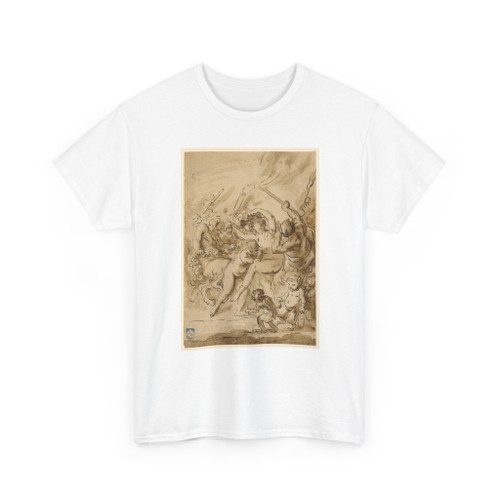
 Jacob de Wit, 1695 – 1754 - Bacchantes - ca. 1750
from $19.99
T-Shirt

Jacob de Wit, 1695 – 1754 - Putti playing before a herm - 1750–1752
Garment
T-Shirt
from $19.99
Ships within 3–7 business days. Free shipping to U.S. addresses.
Bulk offer: any 3 items 10% off, 5 items 20%, 10 items 30%. Applied automatically in the cart.
- Free shipping on all U.S. orders. Flat-rate international shipping: $19.99 USD.
- Made to order. Orders are processed and shipped within 3–7 business days.
- Damaged or misprinted? Free replacement. Report it within 30 days of delivery. Refund & return policy
About this design
Jacob de Wit, 1695 – 1754 - Putti playing before a herm - 1750–1752 - T-Shirt
A pen, brown wash and white-heightened drawing by Jacob de Wit shows a cluster of playful putti gathered beneath a bearded herm, one of them grasping a goat's horns.
Visual Elements & Composition
The sheet is built as a tall vertical panel framed by swags of drapery and foliage. Buff paper tones dominate, with dark brown ink drawing the figures and grey wash softening their forms. White highlights lift the flesh and drapery, giving the scene a bright, sculptural presence. A bearded herm, a head on a tapering pillar, sits at the upper centre and looks down over the group. Below, a nude child holds the goat while other putti crowd in from both sides, and a vessel with handles rests on a ledge at the right.
Meaning & Symbolism
Putti like these belong to the vocabulary of pastoral play and Bacchic revelry, where children mimic the rites of Pan and Dionysus. The herm and the goat point toward the wild, rustic world of the satyr and the sylvan god, and the children teasing the animal make that world feel carefree rather than solemn. Jacob de Wit (1695–1754), an Amsterdam-based painter, built his reputation on decorative schemes of putti, garlands and illusionistic architecture. Studies like this one, dating to the early 1750s, show how he planned such compositions before transferring them to wall and ceiling.
Wearing the Scene
A drawing this detailed rewards a close look, and a tee puts that look right on the chest. The herm sits at the centre of the wearer's torso, with the putti spreading outward across the fabric, so the playful episode reads as you move. Printed on a shirt, the small world of play becomes something you carry through your day rather than something hung on a distant wall.
Same design, other garments
More like this
-
Jacob de Wit, 1695 – 1754 - Bacchantes - ca. 1750
from $19.99
T-Shirt
-
 Jacob de Wit, 1695 – 1754 - Design for a Painting, Five Putti - 1725–1754
from $19.99
T-Shirt
-
 Jacob de Wit, 1695 – 1754 - Design for a Painting, Two Flying Putti - 1725–1754
from $19.99
T-Shirt
-
 Jacob de Wit, 1695 – 1754 - Bacchanal of Children - 1725–1754
from $19.99
T-Shirt
-
 Jacob de Wit, 1695 – 1754 - The Young Bacchus with Two Companions - ca. 1750
from $19.99
T-Shirt